Category: Uncategorized

  • Sizing a Group Order of Custom Hawaiian Shirts: Size Charts, Cut, and How Many of Each

    Sizing a Group Order of Custom Hawaiian Shirts: Size Charts, Cut, and How Many of Each

    Ordering fifty aloha shirts for a team, a wedding party, or a company trip means committing to sizes before anyone tries one on. That is the whole challenge of a group order: you are buying blind, and a handful of wrong guesses either leaves people in shirts that do not fit or forces a second production run at a worse price and a later delivery date. The way to avoid both is to treat sizing as its own small project — measurements first, then cut, then quantities — rather than eyeballing a roster of names.

    Aloha shirts fit differently, so start with a measurement

    A Hawaiian shirt is cut boxier and more relaxed than a modern fitted tee. The camp collar, straight hem, and fuller body are part of the style, which means a shirt that looks right on the hanger drapes rather than hugs. Because of that, sizing off someone’s usual t-shirt size is unreliable; a person who wears a slim medium tee often prefers a large or extra-large aloha shirt for the intended loose drape. The dependable input is a chest measurement in inches, taken around the fullest part of the chest with the tape level and not pulled tight. Collect that one number for everyone you can, and you remove most of the guesswork before it starts.

    Reading the size chart by the chest range

    Every maker publishes a chart that maps a body chest measurement to a garment size, and the ranges are wide because the fit is relaxed. On a representative men’s aloha chart, a small covers roughly a 38 to 42 inch chest, a medium 42 to 44, a large 44 to 48, an extra-large 48 to 52, a 2XL 52 to 54, and a 3XL 54 to 56, with extended sizes running further in both directions. The overlaps at the boundaries are where judgment comes in: someone with a 44 inch chest sits at the top of medium and the bottom of large, and for this cut the more comfortable answer is usually to size up.
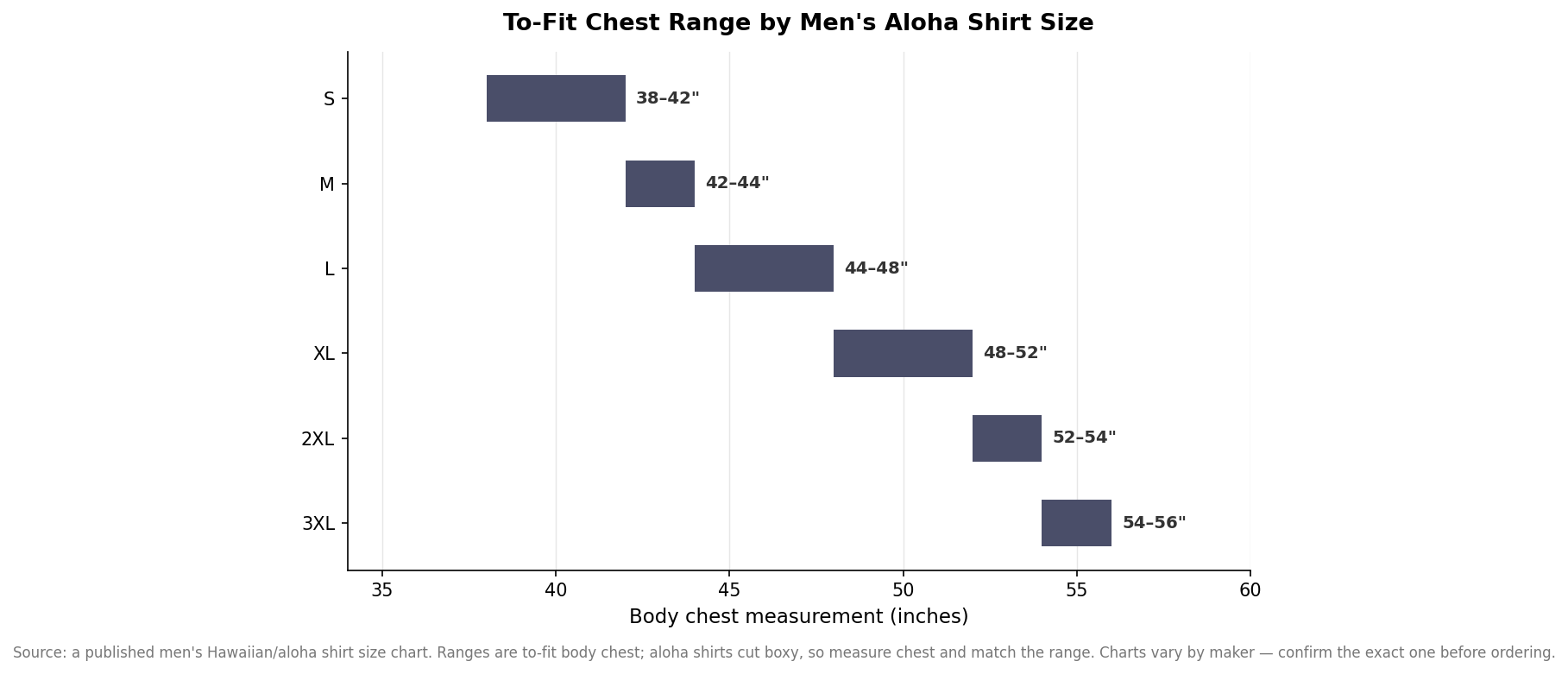
    Horizontal range chart of to-fit chest measurements by men's aloha shirt size from small to 3XL
    To-fit chest ranges overlap at the edges; for the relaxed aloha cut, borderline chests are usually happier sizing up.

    Two cautions when you use any chart. First, these are to-fit body measurements, not the garment’s flat width, so do not measure a favorite shirt and compare it to these numbers directly. Second, charts vary between manufacturers by an inch or two at every size, so pull the exact chart for the specific shirt you are buying rather than a generic one. If your supplier offers a size set or a single sample in a mid-size, order one and measure it flat before you commit the whole run; five minutes with a tape measure settles arguments that a spreadsheet cannot.

    Unisex, men’s, and women’s cuts

    Most bulk aloha programs default to a single unisex or men’s-cut body because it simplifies ordering and looks intentional across a mixed group. That works well for the classic loose look, but it fits a smaller-framed or curvier wearer as a tent rather than a shirt. If part of your group would prefer a shaped fit, ask whether the style comes in a women’s cut, which is typically narrower through the shoulder and slightly shaped at the waist, and treat it as a separate size run with its own chest chart. The cleanest approach for a diverse group is to offer both bodies and let people self-select, then combine the counts when you place the order. Whatever you choose, keep the decorated design identical across cuts so the group still reads as one set.

    How many of each size to order

    Once measurements are in, the counts follow. When you cannot survey everyone, a published distribution for a general mixed adult group is a reasonable starting template: roughly 2% extra-small, 10% small, 25% medium, 30% large, 20% extra-large, 10% 2XL, and 3% 3XL. The practical takeaway is that medium, large, and extra-large together account for about three-quarters of a typical order, so those are the sizes to nail down and, if anything, over-order slightly.
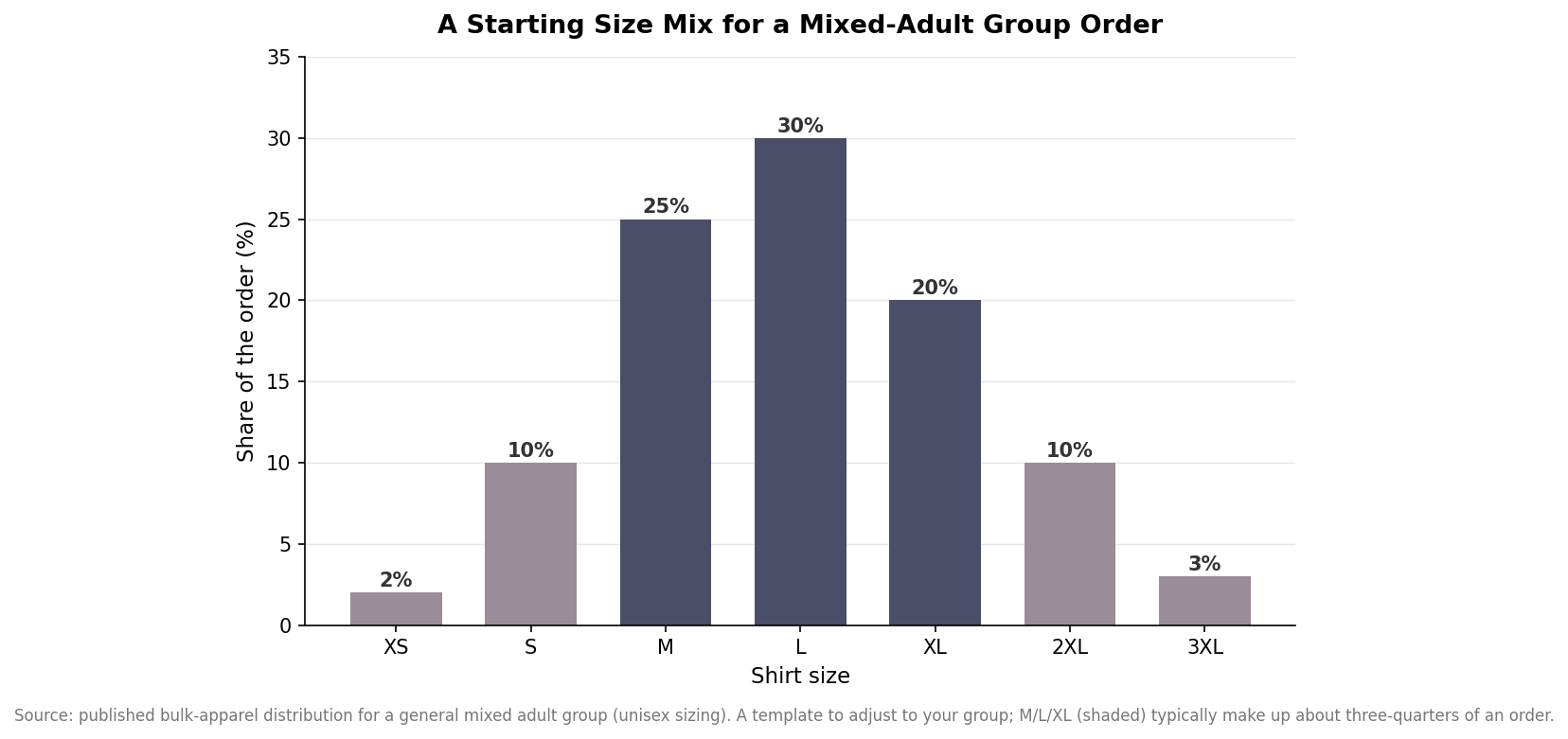
    Column chart of a recommended size mix for a mixed-adult group order, peaking at large and medium
    A default size mix: medium, large, and extra-large together make up about three-quarters of a typical order.

    Treat that curve as a default to bend toward your actual group, not a law. A construction crew, a college rowing team, and a family reunion each skew the shape meaningfully — the crew and the rowing team push the whole distribution up a size or two, while a reunion widens the tails to cover kids and grandparents. Any real headcount you can gather beats the template every time, so run a quick size survey with a link to the chart and let people pick from the same ranges you will order against. Blend the survey results with the template only to fill the gaps for people who never reply.

    Rayon shrinkage, extras, and the second-run trap

    Fabric changes the math at the edges. Rayon, the classic drapey aloha material, can shrink a few percent if it is washed warm or tumbled dry, so for a rayon shirt it is safer to size a borderline person up and to tell recipients to wash cold and hang dry. Cotton behaves similarly unless it is pre-shrunk, while polyester and poly blends hold their size and can be ordered right at the measurement. None of this requires a different chart; it just nudges the borderline calls toward the larger size.

    Finally, plan for the stragglers before they cost you. The most common bulk-order mistake is ordering exactly to the headcount, then discovering three late additions or two shirts that fit wrong, which triggers a small reorder at a higher per-unit price and a fresh lead time. Because unit cost drops with quantity and setup is charged once, buying a modest cushion in medium, large, and extra-large is usually cheaper than a second run and leaves you spares for replacements. Custom aloha shirts commonly come in a size range from extra-small through 3XL or 4XL, with some styles reaching further, so confirm that every size your group needs is available in the specific shirt before you build the order, not after.
  • How Custom Hawaiian Shirts Are Printed: All-Over Cut-and-Sew vs. Printing on Blanks

    How Custom Hawaiian Shirts Are Printed: All-Over Cut-and-Sew vs. Printing on Blanks

    An all-over floral is not printed onto a finished shirt; the shirt is built out of already-printed fabric. That single fact explains most of what surprises first-time buyers of custom Hawaiian shirts, from why the pattern runs cleanly across every seam to why the good version takes longer than decorating a blank shirt. There are really two production routes behind anything sold as a “custom aloha shirt,” and they produce different-looking garments at different prices and timelines. Knowing which one you are ordering is the difference between a shirt that looks the part and one that looks like a logo stuck on a beach shirt.

    Two ways to get a custom Hawaiian shirt

    The first route is printing onto a pre-made shirt. A blank aloha shirt, or a plain shirt, already exists as a finished garment, and a decoration method adds artwork to it. That could be direct-to-garment printing, screen printing, or pressing a sublimation transfer onto the fabric. This is fast and cheap, but it is fundamentally a placement method: you are adding a design to a defined area, like a chest logo or a back panel. Trying to force a true edge-to-edge pattern this way runs into trouble at the seams, underarms, and folds, where the transfer cannot make clean contact and leaves creases and un-printed white patches.

    The second route is cut-and-sew, and it is how genuine all-over Hawaiian shirts are made. Here the fabric is printed first, while it is still flat yardage, and only then is it cut into panels and sewn into a shirt. Because every panel is decorated before assembly, the print reaches seam to seam with no gaps, and the pattern can be lined up across the front placket, the pockets, and the sleeves. It is the more involved, more expensive route, and it is the one that produces the shirt most people actually picture.

    How cut-and-sew all-over printing actually works

    The most common cut-and-sew method for aloha shirts is dye sublimation. The design is printed onto large sheets of sublimation paper, then transferred onto the fabric under heat and pressure, typically around 180 to 210°C, roughly 356 to 410°F. At that temperature the ink turns directly to gas and bonds into the polyester fibers rather than sitting on top of them. The practical result is a print with no hand feel, nothing raised or rubbery to the touch, and colors that will not crack or peel because they are effectively part of the cloth. After the fabric is printed, it is cut to the pattern and sewn together.

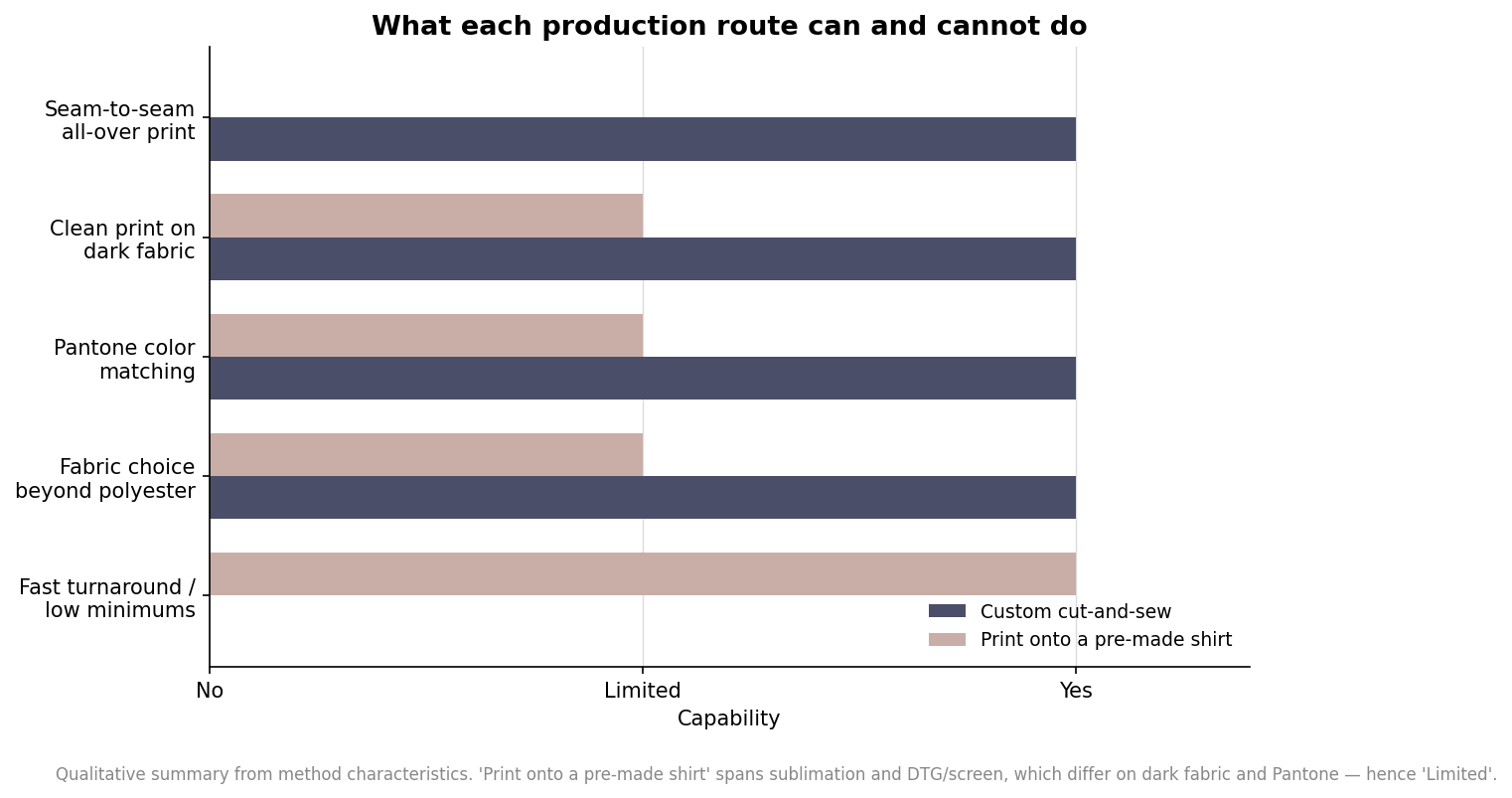
    Grouped horizontal bar chart of capabilities for cut-and-sew versus printing onto a pre-made Hawaiian shirt
    Cut-and-sew reaches seam to seam and handles dark colors; printing on a blank is faster but placement-limited.

    That chemistry carries one firm requirement: sublimation only works on polyester or high-polyester blends, and on light or white fabric. The dye needs polyester molecules to bond with, and it is translucent, so it cannot lay a light pattern over a dark base. This is why the fabric decision and the print decision are linked. If a project needs the drape of rayon or the feel of cotton, sublimation is off the table and the shirt has to be made with a different textile-printing process before cut-and-sew, which changes cost and availability. It is worth settling the fabric question and the print method together rather than picking a cloth and discovering later that it cannot carry the print you wanted.

    What each route can and cannot do

    Beyond coverage, the two routes differ on color and fabric in ways that decide real orders. Cut-and-sew handles dark and richly colored designs, supports a wider range of fabrics including performance and cotton-feel options, and can hold to specified brand colors, so a company teal or a sports-team red stays consistent. Printing onto a pre-made shirt is more constrained: sublimation onto a finished garment is limited to polyester and struggles with dark grounds and exact color matching, while DTG and screen printing can handle darks and specific colors but only within a placement area, not across the whole garment.

    The honest way to read this is by priority. If the entire visual identity of the shirt is the all-over pattern, an event uniform, a themed staff shirt, a bold promotional piece, cut-and-sew is the route that delivers it. If the shirt is essentially a solid or simple base that needs a logo or a small graphic, printing onto a blank is faster, cheaper, and perfectly adequate. Problems happen when someone tries to get the first result on the second route’s budget and timeline.

    Lead time, minimums, and how to specify the order

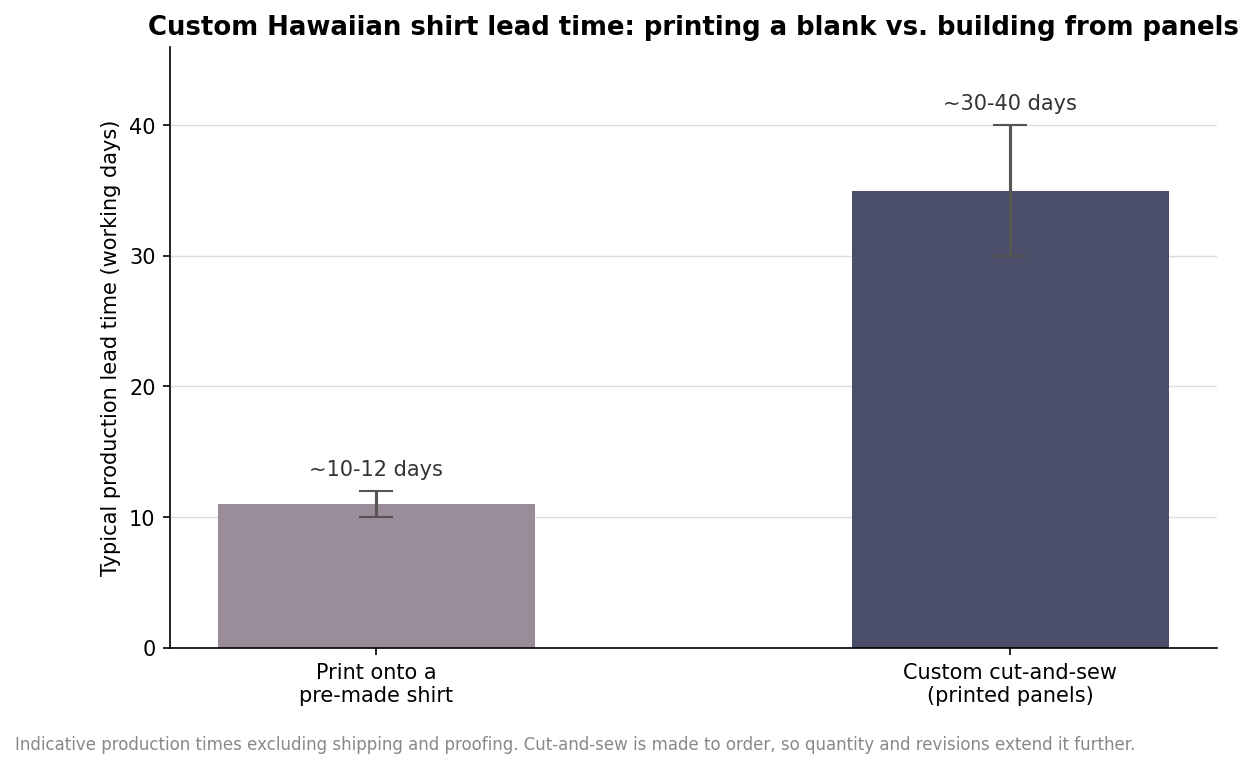
    Timeline is where the two routes separate most sharply, and it is the number most likely to derail an event. Printing onto pre-made shirts is the quicker route, because the garments already exist and only the decoration is added. Cut-and-sew is made from printed fabric up, so it takes longer, and at Customized Hawaiian Shirts finished shirts ship in about 2 weeks from mockup approval, with the free mockup arriving within 24 hours and express turnaround available for fixed dates. Allow time for shipping and for approving the mockup, so build in a buffer.

    When you specify a cut-and-sew order, decide a few things up front to keep it on schedule. Confirm the fabric and confirm it is compatible with sublimation if that is the method, since that constrains color. Provide artwork at full scale as a repeating pattern or an engineered layout, and be explicit about whether the pattern should match across the front opening and pockets, because pattern matching at seams is a design decision, not an automatic outcome. Ask for a proof and, where offered, a physical sample before a full run, keeping in mind that made-to-order cut-and-sew often cannot provide a pre-production sample the way printing on a stock blank can. Lock the size run early, and remember that an all-over pattern can look different at the smallest and largest sizes as the repeat scales across the body. Settle the method first, and the fabric, color, timeline, and budget all follow from that one choice.

  • Rayon, Cotton, or Polyester: Fabric for Custom Hawaiian Shirts

    Rayon, Cotton, or Polyester: Fabric for Custom Hawaiian Shirts

    Choosing fabric for a custom Hawaiian shirt feels like a comfort question, but for anything you are printing yourself it is really a printing question. The pattern you want, the way it wraps around buttons and seams, and whether the color survives a summer of washing all trace back to the cloth underneath. Rayon, cotton, and polyester each behave differently on the body and under a printer, and the fabric that photographs best on a retail rack is not always the one that carries a full custom design. Here is how the three compare, and how to pick for a bulk order rather than a single souvenir.

    What shoppers ask for versus what a custom print needs

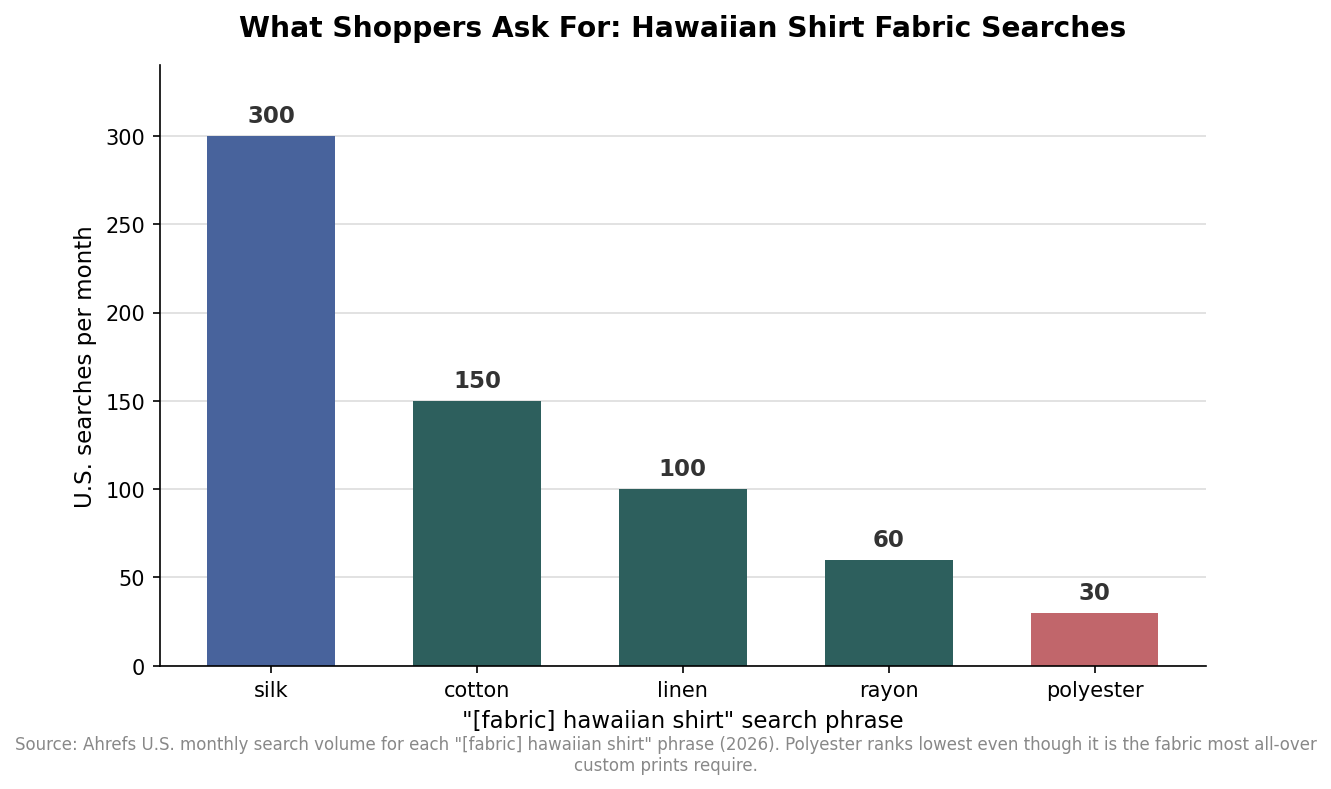
    If you follow what people type into a search bar, the demand leans toward the natural, dressy fibers. Across a typical month, far more shoppers look for silk and cotton Hawaiian shirts than for polyester ones. That instinct makes sense for off-the-rack aloha wear, where drape and hand-feel sell the shirt. It also sets up the central tension of custom work: the fabric buyers romanticize is often the hardest one to decorate with a true edge-to-edge print.

    Bar chart of U.S. monthly search volume for silk, cotton, linen, rayon and polyester Hawaiian shirt phrases
    Shoppers search silk and cotton most, yet polyester is the fabric most all-over custom prints require.

    The reason is how each print method bonds to fiber. A full all-over tropical pattern, the kind that runs across the whole shirt without a visible print border, is almost always produced by dye sublimation, and sublimation ink only fuses permanently to polyester. On natural fibers it simply will not lock in the same way. So the moment your design has to cover the entire garment in your own artwork, the fabric decision is largely made for you, whatever the search trends say.

    Rayon: the classic aloha drape

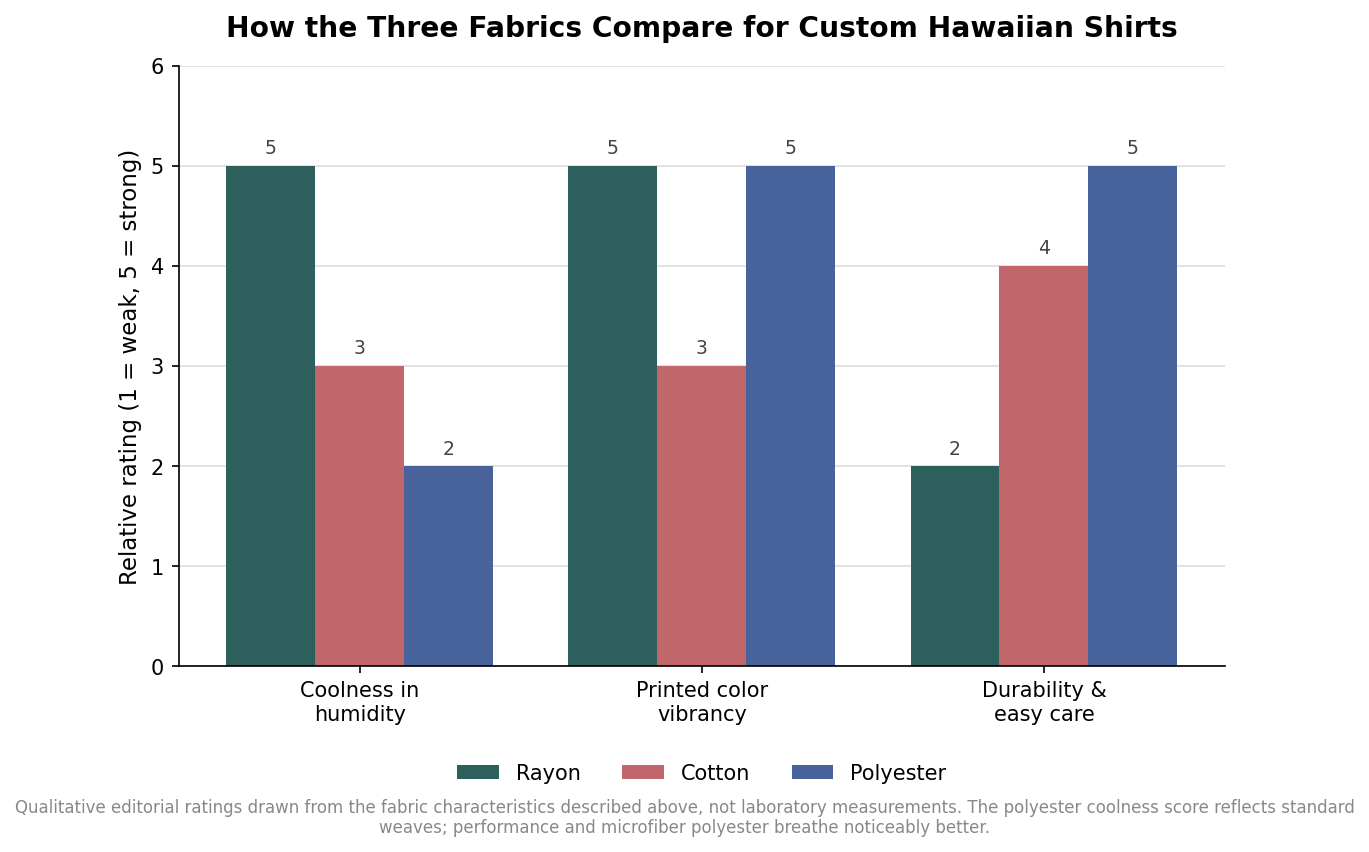
    Rayon is the fabric most people picture when they think of a vintage aloha shirt. It is a manufactured fiber made from processed wood pulp, and it drapes with a smooth, almost silky fall that cotton cannot match. It breathes well and lets moisture evaporate quickly, which is why it reads as cool and comfortable in humid, tropical weather. Because it absorbs dye deeply, printed colors on rayon look bold and saturated.

    The trade-off is fragility. Rayon is delicate: it is prone to wrinkling and shrinking, often calls for a cold wash and air drying, and some constructions ask for dry cleaning outright. For a boutique retail line or a premium personal shirt, that care routine is acceptable. For fifty staff shirts that will be washed hard and often, it is a liability. Rayon also resists the sublimation process that all-over custom prints rely on, so it fits localized decoration better than full-coverage artwork.

    Cotton: durable and everyday

    Cotton is the workhorse of the group. It has a slightly thicker, more structured feel, holds its shape through regular machine washing, and shrugs off the daily wear that would stress a rayon shirt. That durability is why cotton is the sensible base for uniform programs and giveaway shirts that need to survive a season.

    Its weakness is color. Cotton tends to show printed patterns a touch more muted than rayon or polyester, and it can fade faster with repeated washing. It also holds onto moisture, so in extreme humidity it can feel heavier than a rayon or performance fabric. For custom work, cotton is a natural match for screen printing and embroidery, which suit a chest logo, a back print, or a pocket motif rather than an all-over design. If your customization is a brand mark on an otherwise plain or lightly patterned shirt, cotton is a safe, cost-effective choice.

    Polyester: the fabric all-over prints actually need

    Polyester is the least romantic option and the most practical one for genuine custom Hawaiian shirts. It reproduces color strongly, resists fading, and stands up to heavy laundering, which is exactly what a coordinated group order needs. More importantly, it is the fiber dye sublimation was built for, so a detailed, full-bleed tropical print lands vivid and permanent and will not crack or peel the way a heavy surface print can.

    The classic knock on polyester is breathability, and standard poly can feel warm in the heat. That has softened as fabric has improved: performance and microfiber polyester weaves wick moisture and breathe far better than the stiff polyester of a decade ago, closing much of the comfort gap while keeping the printability. For event shirts, teams, and any design that has to cover the whole garment edge to edge, polyester or a high-polyester blend is usually the right call.

    Grouped bar chart comparing rayon, cotton and polyester on coolness, color vibrancy and durability
    A qualitative comparison of the three fabrics across the attributes that matter most for a custom order.

    How to choose for a bulk custom order

    Start from the decoration, not the fiber. If you want your own artwork covering the entire shirt, you are effectively choosing polyester, because that is what sublimation requires; plan on a lightweight performance weave if summer comfort matters. If your customization is a logo or a localized print on a more traditional look, cotton gives you durability and an easy care label, while rayon gives you the premium aloha drape and the richest color at the cost of a fussier wash routine. Blends such as poly-cotton or poly-rayon exist precisely to split the difference, trading a little print vibrancy or a little breathability for a more balanced everyday shirt.

    Two practical notes for a group buy. First, ask how the shirt is printed relative to sewing, since the cleanest all-over patterns are printed on panels that are then cut and sewn, which aligns the design across seams, buttons, and pockets but usually carries a higher minimum. Second, order the full size range in the same fabric and print setup and check a sample before you commit, because a pattern scaled for a medium can look very different stretched across a 3XL. The comfort ratings and characteristics here are drawn from general fabric behavior; confirm the exact weight, weave, and care instructions against your supplier’s specific goods before you approve a run.

  • Choosing Aloha Shirts Staff Will Actually Wear

    A uniform shirt has two jobs that pull against each other. It has to identify the person wearing it, and it has to be comfortable enough that they wear it correctly for ten hours instead of unbuttoning it and pushing the sleeves up.

    Most aloha uniform programs fail on the second one, and the fix is almost always in the fabric rather than the design.

    Start with the floor, not the brand

    An air-conditioned dining room, a poolside bar and a marina dock are three different garments. Rayon is a pleasure indoors and a liability in direct sun; wicking polyester is the reverse, comfortable outdoors and slightly formal-looking under restaurant lighting.

    If you have both environments, order both fabrics in the same print. They will read as one uniform from any distance that matters.

    Laundry is the real durability test

    Commercial laundry is hotter, harsher and more frequent than anything a shirt sees at home, and it is what actually ends the life of a uniform garment. Printed-on decoration cracks; dye-sublimated pattern cannot, because the ink is inside the fiber.

    For embroidery, ask for a cut-away stabilizer rather than tear-away. It is the difference between a logo that lies flat after fifty washes and one that ripples after ten.

    Make the logo legible over a print

    A busy floral behind a printed logo turns the logo into texture. Embroidery solves it physically — thread has height and catches light, so it separates from the background regardless of what the background is doing.

    The other solution is a tonal print: the same floral in two shades of one color, quiet enough that a printed or stitched mark reads cleanly. Fine dining rooms almost always end up here.

    Cut for movement

    Reaching, carrying and bending pull a shirt out of shape and out of a waistband. A little mechanical stretch through the shoulder, vented side seams and a slightly longer back hem cost nothing and remove most of the complaints.

    Offer both a unisex and a tailored fit. Uniform compliance improves sharply when people are not being asked to wear a shape that does not suit them.

    Plan the reorder before the first order

    Staff turnover means you will reorder in odd quantities forever. Ask that the digitized embroidery file and the print file are kept, so shirt number four hundred matches shirt number one instead of approximately matching it.

    We keep both as standard and our minimum is twelve, so topping up a rota is a real order rather than a favor.

    What we would specify

    Indoor dining: rayon, tonal print, embroidered left chest, tailored and unisex fits. Poolside and outdoor: wicking stretch polyester, all-over print, UPF finish, vented seams. Retail floor: poly microfiber all-over print in the house pattern, because the staff shirt and the product are then the same thing.

  • Why Group Shirts Look Wrong at the Extremes of the Size Run

    Every matching set is judged in a photograph, and in that photograph the eye goes straight to whoever looks least like everyone else. Nine times out of ten that is the smallest person or the largest one, and the cause is print scale.

    What a repeat actually is

    An all-over pattern is a tile that repeats across the printed fabric. A shirt is cut out of that fabric, so a small shirt contains fewer whole tiles than a large one.

    If the tile is big and bold, a small shirt catches two or three motifs and reads as a crop of something. If the tile is fine and dense, a 5XL reads as texture rather than pattern. Neither is a printing fault; both are scale decisions made once, for the middle of the size run.

    The fix for adult sizes

    Check the repeat at your largest and smallest adult size before approving, not at medium. Usually the answer is a slightly smaller, denser tile than looks right on its own, because density survives being scaled up better than boldness survives being cropped.

    If the design has one hero motif — a crest, a big bloom — place it deliberately rather than letting the repeat put it wherever it falls. Chest and back placement can be pinned per size.

    Youth sizes need a different scale, not a smaller shirt

    A child’s shirt cut from adult-scale fabric shows perhaps one and a half motifs, which does not read as the same design at all. The pattern has to be rescaled proportionally for the youth run so the two shirts match when the wearers stand together.

    That is a separate print setup rather than a discount, and it is why so many family sets look subtly wrong. Ask specifically whether the youth print is rescaled.

    Names and numbers change the layout

    Personalization has to sit somewhere the pattern is not fighting it. On a busy print that usually means a solid or tonal panel behind the name, placed on the back yoke or above the pocket.

    Decide this before approval, because adding a name to an approved all-over design after the fact means moving the pattern, not just adding text.

    Order the size list you have

    Collect actual sizes rather than guessing a distribution. Groups skew larger than the internet does, and the missing 4XL is the shirt people remember.

    Mixed runs cost no more here and youth counts toward the same minimum of twelve, so there is no reason to round anyone up or down.

    What to check on the mockup

    Three things: the repeat at your largest size, the repeat at your smallest, and where the hero motif lands on the chest. If those three are right the whole run will be right, and if any of them is wrong no amount of print quality will save the photograph.

  • The Complete Buyer’s Guide to Custom Hawaiian Shirts

    Ordering patterned shirts in bulk goes wrong in predictable ways, and almost all of them trace back to one decision made early and never revisited: whether the shirt is being made for you or merely decorated for you.

    This guide walks the four decisions in the order they actually matter, and flags the details — repeat scale, size mix, collar type — that quietly determine whether the finished run looks deliberate.

    Decision one: cut-and-sew or decorated blank

    A decorated blank starts as a finished shirt. Whatever you put on it lands inside the boundaries of the panel, which is why the pattern stops before the seam and why the back and the sleeves usually go plain.

    Cut-and-sew prints the fabric on the roll first, then cuts and stitches the shirt from it. The pattern runs off every edge, over the shoulder and around the side. It costs more per shirt and it is the only route to a shirt that reads as a Hawaiian shirt rather than a tee with flowers on it.

    Decision two: the fabric

    Rayon has the drape the originals had. It falls softly, breathes, and takes a floral with a slight softness that suits it. It is the right answer for anything worn socially, sold at retail, or photographed at a wedding.

    Poly microfiber is the value option for all-over print and holds color brilliantly. Wicking stretch polyester is for people working outdoors in it — dries fast, sheds wrinkles, carries a UPF finish, and survives daily commercial laundry that would finish rayon in a season.

    Decision three: print or embroidery

    On a patterned shirt, a printed logo competes with the print behind it and usually loses. Embroidery sits proud of the fabric, catches light, and stays legible over a busy background, which is why nearly every uniform aloha shirt uses it.

    The exception is when the logo is the pattern — a repeat built from your own icons, printed across the whole garment. That is a different and often better idea than a chest logo, and it costs the same.

    Decision four: how the repeat is scaled

    This is the one nobody asks about and everybody notices. A repeat that looks balanced on a size medium can be overwhelming on a 5XL and unreadable on a 4T, because the same tile is being cut from a bigger or smaller piece of the same printed roll.

    Ask for the repeat to be checked at your largest and smallest size before approval. We do it as standard and show both on the mockup, which is usually the moment somebody changes their mind about scale.

    Sizing a group order

    Order the size list you actually have, not a bell curve. Groups skew larger than people expect and the two shirts nobody ordered are always the 4XL and the 5XL, which are the two that ruin the photograph.

    Mixed size runs carry no surcharge here and youth sizes count toward the same minimum, so there is no reason to round anything.

    Details that matter more than they sound

    A camp collar that sits flat when open is what makes the shirt look right unbuttoned. A chest pocket cut so the pattern matches the panel behind it is the single clearest signal that the shirt was made rather than assembled. Coconut-look buttons and a straight hem finish it.

    None of these cost extra. They are just decisions somebody has to make on purpose.

    What to send us

    Your artwork or a description of what you want, the fabric you are leaning toward, a size list, and your date if you have one. If names go on individual shirts, send a spreadsheet with a name and a size per row.