Ordering fifty aloha shirts for a team, a wedding party, or a company trip means committing to sizes before anyone tries one on. That is the whole challenge of a group order: you are buying blind, and a handful of wrong guesses either leaves people in shirts that do not fit or forces a second production run at a worse price and a later delivery date. The way to avoid both is to treat sizing as its own small project — measurements first, then cut, then quantities — rather than eyeballing a roster of names.
Aloha shirts fit differently, so start with a measurement
A Hawaiian shirt is cut boxier and more relaxed than a modern fitted tee. The camp collar, straight hem, and fuller body are part of the style, which means a shirt that looks right on the hanger drapes rather than hugs. Because of that, sizing off someone’s usual t-shirt size is unreliable; a person who wears a slim medium tee often prefers a large or extra-large aloha shirt for the intended loose drape. The dependable input is a chest measurement in inches, taken around the fullest part of the chest with the tape level and not pulled tight. Collect that one number for everyone you can, and you remove most of the guesswork before it starts.
Reading the size chart by the chest range
Every maker publishes a chart that maps a body chest measurement to a garment size, and the ranges are wide because the fit is relaxed. On a representative men’s aloha chart, a small covers roughly a 38 to 42 inch chest, a medium 42 to 44, a large 44 to 48, an extra-large 48 to 52, a 2XL 52 to 54, and a 3XL 54 to 56, with extended sizes running further in both directions. The overlaps at the boundaries are where judgment comes in: someone with a 44 inch chest sits at the top of medium and the bottom of large, and for this cut the more comfortable answer is usually to size up.
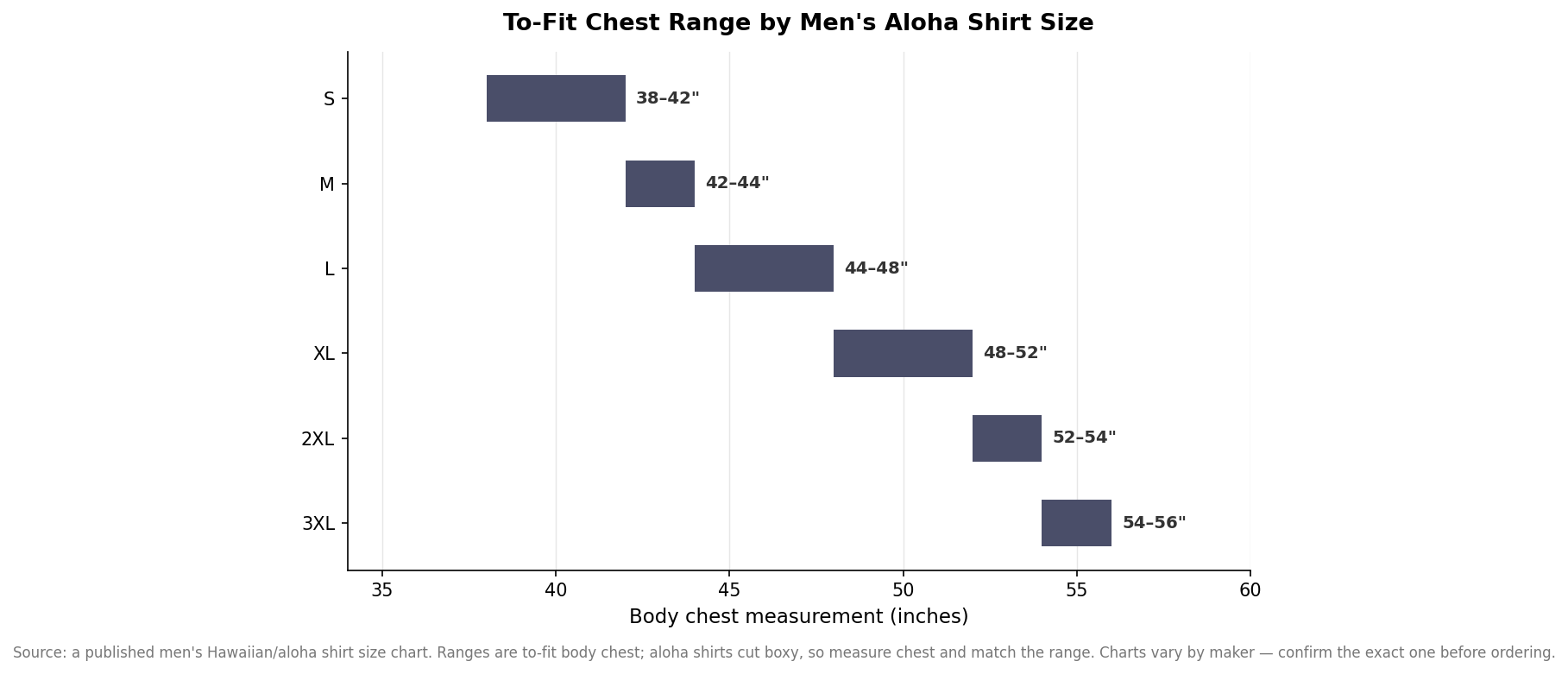
Two cautions when you use any chart. First, these are to-fit body measurements, not the garment’s flat width, so do not measure a favorite shirt and compare it to these numbers directly. Second, charts vary between manufacturers by an inch or two at every size, so pull the exact chart for the specific shirt you are buying rather than a generic one. If your supplier offers a size set or a single sample in a mid-size, order one and measure it flat before you commit the whole run; five minutes with a tape measure settles arguments that a spreadsheet cannot.
Unisex, men’s, and women’s cuts
Most bulk aloha programs default to a single unisex or men’s-cut body because it simplifies ordering and looks intentional across a mixed group. That works well for the classic loose look, but it fits a smaller-framed or curvier wearer as a tent rather than a shirt. If part of your group would prefer a shaped fit, ask whether the style comes in a women’s cut, which is typically narrower through the shoulder and slightly shaped at the waist, and treat it as a separate size run with its own chest chart. The cleanest approach for a diverse group is to offer both bodies and let people self-select, then combine the counts when you place the order. Whatever you choose, keep the decorated design identical across cuts so the group still reads as one set.
How many of each size to order
Once measurements are in, the counts follow. When you cannot survey everyone, a published distribution for a general mixed adult group is a reasonable starting template: roughly 2% extra-small, 10% small, 25% medium, 30% large, 20% extra-large, 10% 2XL, and 3% 3XL. The practical takeaway is that medium, large, and extra-large together account for about three-quarters of a typical order, so those are the sizes to nail down and, if anything, over-order slightly.
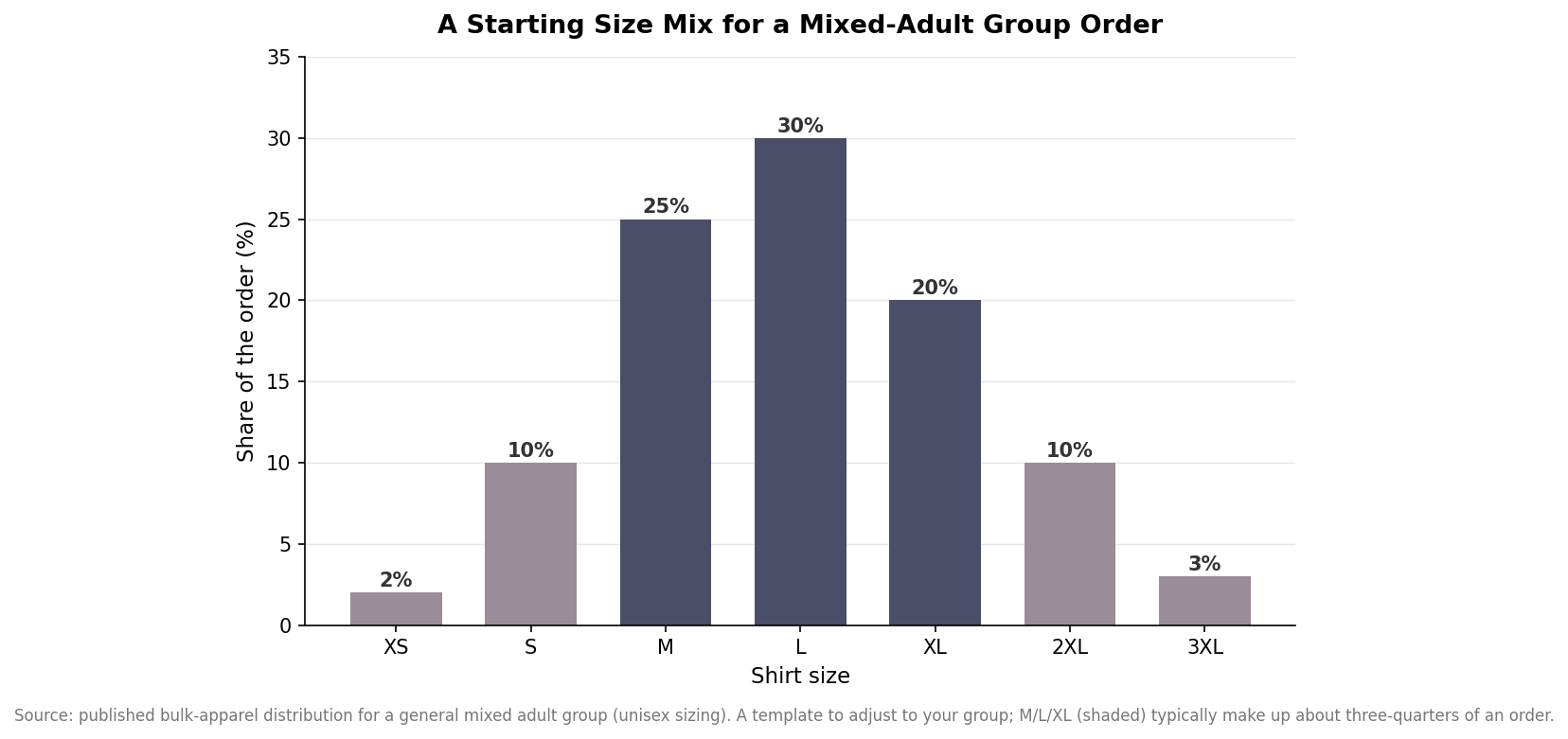
Treat that curve as a default to bend toward your actual group, not a law. A construction crew, a college rowing team, and a family reunion each skew the shape meaningfully — the crew and the rowing team push the whole distribution up a size or two, while a reunion widens the tails to cover kids and grandparents. Any real headcount you can gather beats the template every time, so run a quick size survey with a link to the chart and let people pick from the same ranges you will order against. Blend the survey results with the template only to fill the gaps for people who never reply.
Rayon shrinkage, extras, and the second-run trap
Fabric changes the math at the edges. Rayon, the classic drapey aloha material, can shrink a few percent if it is washed warm or tumbled dry, so for a rayon shirt it is safer to size a borderline person up and to tell recipients to wash cold and hang dry. Cotton behaves similarly unless it is pre-shrunk, while polyester and poly blends hold their size and can be ordered right at the measurement. None of this requires a different chart; it just nudges the borderline calls toward the larger size.
Finally, plan for the stragglers before they cost you. The most common bulk-order mistake is ordering exactly to the headcount, then discovering three late additions or two shirts that fit wrong, which triggers a small reorder at a higher per-unit price and a fresh lead time. Because unit cost drops with quantity and setup is charged once, buying a modest cushion in medium, large, and extra-large is usually cheaper than a second run and leaves you spares for replacements. Custom aloha shirts commonly come in a size range from extra-small through 3XL or 4XL, with some styles reaching further, so confirm that every size your group needs is available in the specific shirt before you build the order, not after.