Choosing fabric for a custom Hawaiian shirt feels like a comfort question, but for anything you are printing yourself it is really a printing question. The pattern you want, the way it wraps around buttons and seams, and whether the color survives a summer of washing all trace back to the cloth underneath. Rayon, cotton, and polyester each behave differently on the body and under a printer, and the fabric that photographs best on a retail rack is not always the one that carries a full custom design. Here is how the three compare, and how to pick for a bulk order rather than a single souvenir.
What shoppers ask for versus what a custom print needs
If you follow what people type into a search bar, the demand leans toward the natural, dressy fibers. Across a typical month, far more shoppers look for silk and cotton Hawaiian shirts than for polyester ones. That instinct makes sense for off-the-rack aloha wear, where drape and hand-feel sell the shirt. It also sets up the central tension of custom work: the fabric buyers romanticize is often the hardest one to decorate with a true edge-to-edge print.
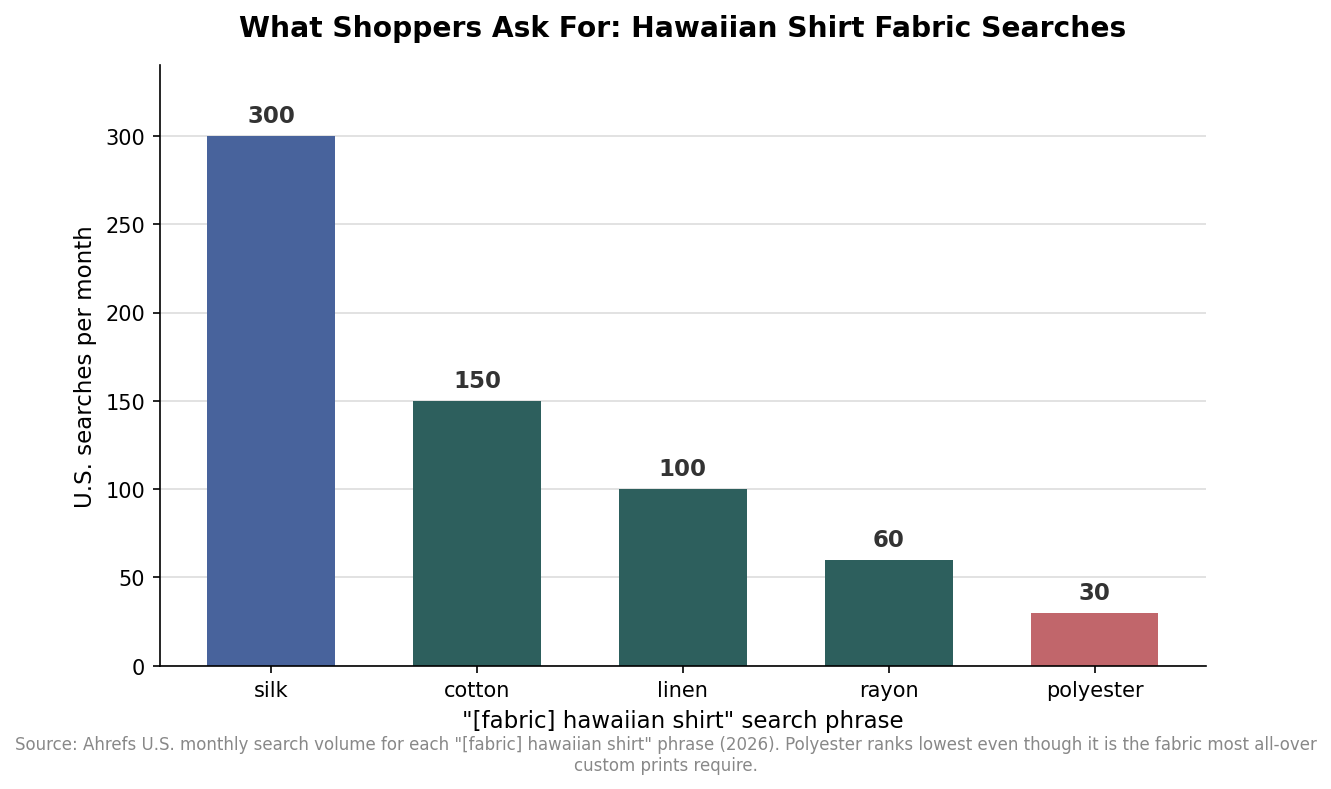
The reason is how each print method bonds to fiber. A full all-over tropical pattern, the kind that runs across the whole shirt without a visible print border, is almost always produced by dye sublimation, and sublimation ink only fuses permanently to polyester. On natural fibers it simply will not lock in the same way. So the moment your design has to cover the entire garment in your own artwork, the fabric decision is largely made for you, whatever the search trends say.
Rayon: the classic aloha drape
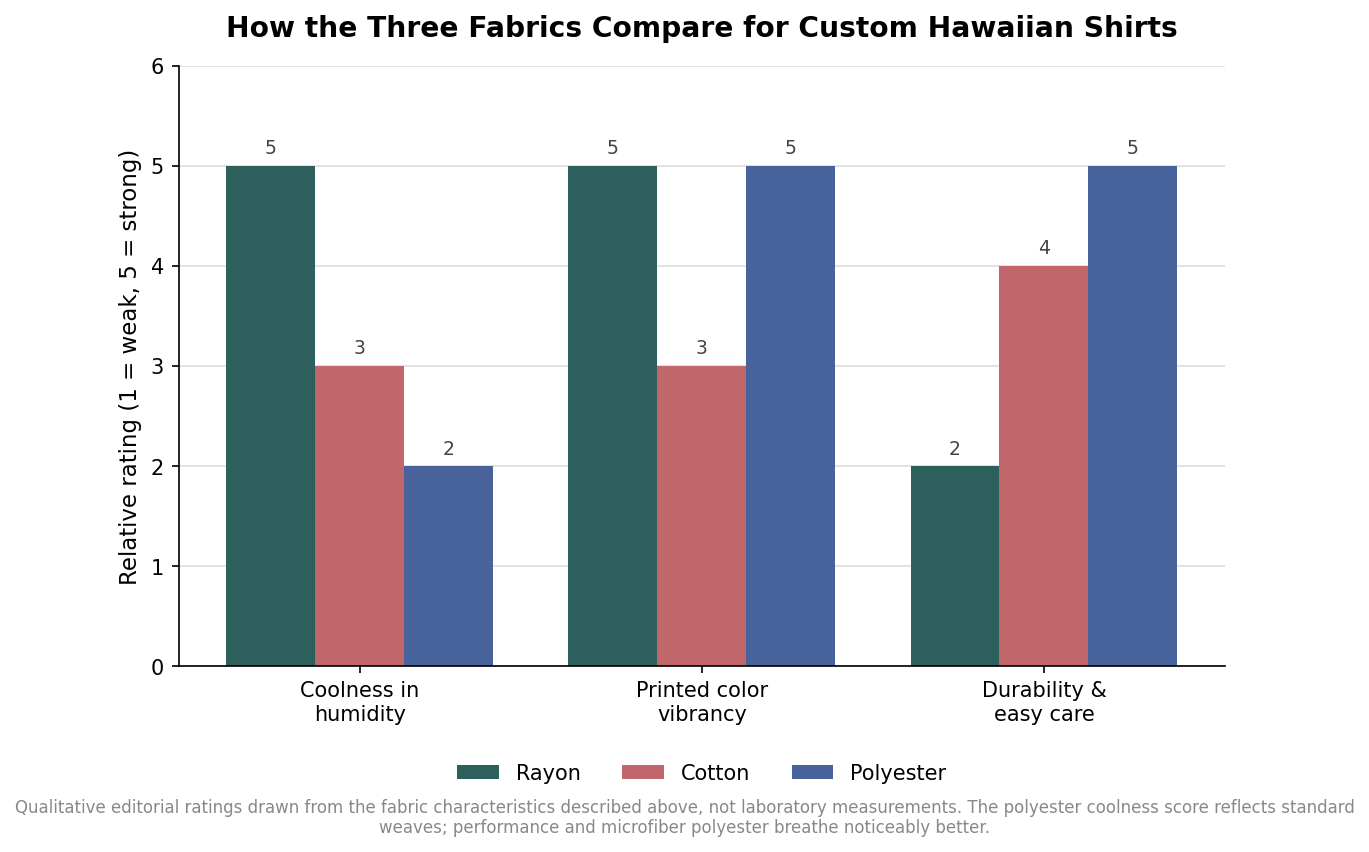
Rayon is the fabric most people picture when they think of a vintage aloha shirt. It is a manufactured fiber made from processed wood pulp, and it drapes with a smooth, almost silky fall that cotton cannot match. It breathes well and lets moisture evaporate quickly, which is why it reads as cool and comfortable in humid, tropical weather. Because it absorbs dye deeply, printed colors on rayon look bold and saturated.
The trade-off is fragility. Rayon is delicate: it is prone to wrinkling and shrinking, often calls for a cold wash and air drying, and some constructions ask for dry cleaning outright. For a boutique retail line or a premium personal shirt, that care routine is acceptable. For fifty staff shirts that will be washed hard and often, it is a liability. Rayon also resists the sublimation process that all-over custom prints rely on, so it fits localized decoration better than full-coverage artwork.
Cotton: durable and everyday
Cotton is the workhorse of the group. It has a slightly thicker, more structured feel, holds its shape through regular machine washing, and shrugs off the daily wear that would stress a rayon shirt. That durability is why cotton is the sensible base for uniform programs and giveaway shirts that need to survive a season.
Its weakness is color. Cotton tends to show printed patterns a touch more muted than rayon or polyester, and it can fade faster with repeated washing. It also holds onto moisture, so in extreme humidity it can feel heavier than a rayon or performance fabric. For custom work, cotton is a natural match for screen printing and embroidery, which suit a chest logo, a back print, or a pocket motif rather than an all-over design. If your customization is a brand mark on an otherwise plain or lightly patterned shirt, cotton is a safe, cost-effective choice.
Polyester: the fabric all-over prints actually need
Polyester is the least romantic option and the most practical one for genuine custom Hawaiian shirts. It reproduces color strongly, resists fading, and stands up to heavy laundering, which is exactly what a coordinated group order needs. More importantly, it is the fiber dye sublimation was built for, so a detailed, full-bleed tropical print lands vivid and permanent and will not crack or peel the way a heavy surface print can.
The classic knock on polyester is breathability, and standard poly can feel warm in the heat. That has softened as fabric has improved: performance and microfiber polyester weaves wick moisture and breathe far better than the stiff polyester of a decade ago, closing much of the comfort gap while keeping the printability. For event shirts, teams, and any design that has to cover the whole garment edge to edge, polyester or a high-polyester blend is usually the right call.
How to choose for a bulk custom order
Start from the decoration, not the fiber. If you want your own artwork covering the entire shirt, you are effectively choosing polyester, because that is what sublimation requires; plan on a lightweight performance weave if summer comfort matters. If your customization is a logo or a localized print on a more traditional look, cotton gives you durability and an easy care label, while rayon gives you the premium aloha drape and the richest color at the cost of a fussier wash routine. Blends such as poly-cotton or poly-rayon exist precisely to split the difference, trading a little print vibrancy or a little breathability for a more balanced everyday shirt.
Two practical notes for a group buy. First, ask how the shirt is printed relative to sewing, since the cleanest all-over patterns are printed on panels that are then cut and sewn, which aligns the design across seams, buttons, and pockets but usually carries a higher minimum. Second, order the full size range in the same fabric and print setup and check a sample before you commit, because a pattern scaled for a medium can look very different stretched across a 3XL. The comfort ratings and characteristics here are drawn from general fabric behavior; confirm the exact weight, weave, and care instructions against your supplier’s specific goods before you approve a run.